Sunday, August 24, 2008
=================================================================
glisten: The Work of the Father
My Pops had been a Metro bus driver in Nashville for some time and it didn't suit him well. While visiting family in New York City, he passed by the now-venerable House of Oldies and spied a record in the window selling for a hundred dollars. Earlier that year he had picked up a copy of the same disc for two bits. He hadn't been aware that there was a market for such stuff, a coterie of vinyl and shellac obsessives willing to pay far beyond top dollar for rare and historically important recordings. A light went off. Pops, a Yankee expat living South of the Mason/Dixon, saw the potential for a potentially lucrative hustle that played well off a lifetime of fascination with music. In 1975, the year I was born, my father decided to buy and sell antique records for a living.
In those pre-bay times, Tennessee was a collector's paradise; over a half century of music and radio industry unique to the area produced literally hundreds of thousands of undervalued records left unused or forgotten in garages, parlors, basements. A curious crate digger could find warehouses filled with untrammelled pickings. Initially, Pops would cart bulk piles of 45's and 78's into the city to sell but he quickly adopted a business model that would require less hauling and a different sort of focus.
Once a year, he would print and mail a thick pamphlet of the thousands of meticulously graded records and musical memorabilia he had acquired (or, as eventually became more common, that he was selling on consignment) to an international community of several hundred select buyers. Those buyers would send their lists of requests along with a price they were willing to pay for each of their picks. A month or so later, Pops would pull all the high bids and write the winners to confirm purchase. They would send checks. He would clean and pack the records then drive vanloads, many vanloads, of boxes to the local post office. Everybody at the post office knew him by name. In the background, while he's working, he's always playing an eclectic mix of music; sometimes favorite albums but more often whatever it is that he's just found to sell. Seventy-five percent of my childhood had an ever-changing soundtrack.
Pops has run this mail-order auction for over thirty years in pretty much the same fashion I've detailed above. It fills six to eight months of his year, every year, with packing and cleaning and grading and acquiring and mailing. I've watched him do it; it's a numbing sort of grind that often left him frazzled and irritable; hands cracked from the rubbing alcohol he used to clean the records, shut up in a home office walled by cardboard and vinyl, burning early morning hours appraising disc after disc. He has always done all this work by himself and continues to do so. His main mechanical aide well into the late nineties was a typewriter. He has a computer now but he uses it solely as a word processor. To the best of my knowledge, he has never opened Excel; all his financial mathematics are done on paper or with a calculator. He does not have an internet connection.
Pops realized early enough that simply selling records wasn't going to fulfill his needs; he needed to add a creative or educational element to this work to make it worthwhile. When my father began his business, there were limited resources available to learn more about the artists and groups that populated his favorite songs. Constant exposure to the people who sold and bought these sort of records brought him into contact with a mostly unwritten history that caught his imagination. He began to form an identity as an independent musical scholar in the styles of music indigenous to the South: blues, rhythm and blues, bluegrass. He was particularly taken with the vast and rich tradition of Southern gospel recording, the race records of the twenties through the late forties. Many of the artists had 'Bessemer' or 'Birmingham' attached to the band name. Alabama, like Tennessee, presented plenty of opportunity for record scavenging and my ex-busdriving father liked to take road trips. On one such trip, he came upon an unlikely name in the local phone book that matched with a singer he was familiar with via old recordings. He made the call and found a surprised Reverend on the other end who wasn't entirely clear why this white boy wanted to talk with him but who would be willing to meet. Pops bought a tape recorder and some blanks and interviewed the man.
This felt worthwhile.
One singer referred him to another. He'd meet with these men and women and discuss lives and careers some forty years past and mostly forgotten; they appreciated his respect and inquisitiveness. Conversations would lead to questions that would lead to new singers and new conversations. My father filled hundreds of tapes, transcribed many of them. He began writing essays on these bands for specialty magazines and academic magazines. His interviews became an exclusive base of knowledge that he would refer to while researching the history of the bands.
Recently, my father has approached me about helping with a project relating to these tapes. About three years ago, Pops bought a machine that would transfer audio to CD. He's been copying over the now decaying tapes and it's brought some ideas to mind that he'd like to share. He asked if I'd be willing to help him "publish" some of these audio interviews on The Tofu Hut. I warned him that my inactivity on the site and resulting lack of attention here likely meant that it wouldn't exactly be the best place to expose new material but he seems to believe that these short pieces might provide historians some new information or perspective on the bands in question, that just getting the material out there onto Google is good enough. I gave the interviews he had compiled a listen and it is pretty fascinating stuff, accompanied by some fairly rare music that Pops dubbed directly from record. I decided to do it.
Pops sent two entries worth of material along with a "let's see how this goes" note, so you'll see at least one more post of this nature. Before beginning, he wanted me to share the following caveats:

The Golden Gate Quartet, circa 1943 - At Piano: Conrad Frederick (bearing more than a slight resemblance to Andre 3K)
Left to Right: Orlandus Wilson, Bill Johnson, Henry Owens and Clyde RiddickThe first post in this series is an excerpt from an interview I taped with Bill Johnson in his home in Los Angeles on January 23, 1980. Johnson was the lead singer, music arranger and general mastermind of the original Golden Gate Jubilee Quartet which was formed in Norfolk, Virginia early in the 1930s. Johnson was born in Washington, North Carolina, May 2, 1913. He died May 3rd, 1980.
When I asked Bill Johnson about his earliest musical inspirations, he told me the following story about attending St. Stephen's Baptist Church in Jarvisburg, North Carolina. A rough transcription follows; you can listen to the original recording of our conversation by clicking on the link.
"Now let me try to explain this. As a kid and going to the churches when I was still in North Carolina, there was an old man called Obadiah. And Uncle Obie, that's what everybody used to call him, he must have come directly from Africa or either he was the second generation out. Because, in the mornings he would get up and he would come out, call himself 'waking up the neighborhood' and he could practically do it too. Had a voice that carried just like a bullhorn. And he would get up in the mornings and he'd go 'Whoo Whoo, Wheet Whoo, Haah!' One of those things. And he would do that several times, and people [inaudible phrase], 'Obie's up, time for us to turn too.' And he used to go to the church where I was going at the time as a kid. And he would be, how would you put it… You know how the chiefs of the African tribes would narrate happenings and that sort of thing, but all of his things was things from the Bible. He would sing them with some type of rhythm behind then. I think that's what got me on the rhythm kick. Because he had such a natural rhythm you know. And he'd have, just before the services, before the preacher got - I never shall forget it, old Reverend Arnold that was his name - just before the preacher would start to preach old Uncle Obadiah would get up, and he'd start to walking the aisles. And he would start [sings]: 'A hey-hey-hey,' and he'd say 'and a ha-ha-ha.' And then the sisters would take it: 'A hey-hey-hey,' and he'd say 'and a ha-ha-ha.' Then he would say 'come along children, do come along. Shuffle up, shuffle up a hey-hey-hey.' That was the answer. And this beat sort of got into you after a while. And all of the things that he used to sing really started like that. They would start down here and they would keep moving up, until they really got into a frenzy of a beat. And I guess that's about what attracted me to it."
Not long ago, I obtained a dub of a 16" radio transcription by the Golden Gate Quartet (NBC Thesaurus No. 1122) which they recorded in New York in 1943. It includes a song which the Gates never released commercially called 'Jubilee'. Johnson is singing the lead. It reminds me of the bit of adlib vocalizing he had done for me that day in 1980.
The Golden Gate Quartet - 'Jubilee'
Our conversation continued:
"With this quartet, what we tried to create was what I used to call 'vocal percussion.' It was vocal percussion, it was just like a drum. But it had notes to it, it had lyrics to it. And you had different beats, you had different accents. You would accent it here, accent it here, but whatever was done was done together. So what I used to call it 'percussion.' It was really a vocal percussion…
"Like a bunch of guys beating a tom-tom somewhere. And that is what it had to sound like, and it all had to be done sharply and together. And I think that is what made, along with the harmony, and we sang simple chords, the simple triad. The furthest away we got from the simple triad perhaps would be a diminished chord… we sang minor sevenths. And that's about as far as we got. We were trying to sing chords that sounded good to the ear. And in some places in some of the songs there would be only two parts; but it went so fast you couldn't hear it. And the obligatos were, like [Henry] Owens would take an obligato, he'd sing in the cracks. But it fitted in because he slid from the key from the note to the crack, to the note, to the crack, and home. Most of his moans, if you're listening to a lot of things he does when he's moaning behind there, he's dead in the crack in most instances."

The Golden Gate Quartet, circa 1940 - Left to Right: Orlandus Wilson, Willie "Bill" Johnson, Henry Owens, Bill LangfordIn February of 1995, I had the opportunity to spend several days in the company of the great Golden Gate Quartet bass singer Orlandus "Dad" Wilson, who joined the quartet in 1934 and remained a member until his death in 1999. I recited to Dad Wilson what Bill Johnson had told me about "vocal percussion" in order to get his reaction and comments. Here's the audio of his response, following my brief introduction of the topic:
"That's why, with the Golden Gates' style, when you took the bass out you had nothing there. The bass was the percussion that kept it going. Like in things that he's talking about there… the bass started off with the percussion beat. In the case of 'My Walking Stick,' the bass started up [sings:] 'Whump, whump, whump, whump, whump. Without my walking stick…' This is what he is talking about in the percussion. When you had that percussion beat there, the other three voices could do anything around that. They could make any cutoff, they could make any chop, they could make any hole. What the other people don't realize is it's not actually a hole there, because the percussion is still going on, the beat is going on. But the other three voices are not there at that particular time. It is after that, 'whump, Daah, whump, daah de doo dah, whump, daah da de dah… You see? They are filling in everything that has to be filled in."
"Uh huh. They're filling in, instead of the bass singer trying to fill in."
So you see, the bass is the percussion that is carrying that beat. They are free to do anything around that. This is what a lot of people don't realize with the style of the Golden Gate Quartet. This was the Golden Gate Quartet style."
Here is the wonderful song that Wilson refers to in that conversation, 1939's 'My Walking Stick'.
The Golden Gate Quartet - 'My Walking Stick'
Dad Wilson made no bones about the fact that it was Bill Johnson who was the creative genius behind the Golden Gate Quartet. But he also gave credit to their great falsetto tenor Bill Langford, known as "Highpockets," or "Pocket" for short:
"Langford had an important part in this. I will say this: Langford was such a rhythmic cat that he would amaze all of us in some of the things that he could do. He would do some kick-ins some time, that Bill Johnson would stop and laugh, say 'Pocket, you really got it!' He would be amazed that Langford would kick-in like that, you know. Sometimes he would say, excuse the expression that I use, 'Highpocket there is really kicking us in the ass.' And that's the way it was. You know."
"That's what it is with the Gates. It's movement. The thing has to be propelled forward."
"Yeah. But Langford has such a sense of rhythm, of filling in a spot. And he had the imagination that he saw the spot before we could get to it; that it would be vacant and he is there."
Here is an excellent example of Langford's kinetic vocalization and a prime cut from The Gates songbook, 'Found A Wonderful Savior,' from 1937.
The Golden Gate Quartet - 'Found a Wonderful Savior'

Pops and Dad Wilson at The Fisk University Chapel; Feb. 1995 - Photo credited to Robie Cogswell=================================================================
tell me more
Buy compilations of the vast majority of The Golden Gate Quartet's discography from UK label Document records. With shipping and handling included, these come out to about nineteen bucks US a pop.
For those looking for a better deal, I'd recommend EMusic, which carries a considerable amount of the Document catalog. That route puts them at roughly ten dollars an album.
-
Visit the official website for the current iteration of The Gates.
-
Explore a brief history of the band and a selected discography at the Vocal Group Hall of Fame website.
-
Read a short essay by gospel musician and scholar (and family friend) Tony Backhouse detailing some good starting point purchases for the curious Golden Gate neophyte.
-
Listen to The Gates perfom 'Hush' and 'The Sun Didn't Shine'.
-
As was common for popular vocal groups of their era, The Gates appeared in numerous cameo roles for major Hollywood movies (including this somewhat demeaning but utterly outstanding turn in 1942's 'Star Spangled Rhythm') and starred in many theatrically released musical shorts.
Watch 'The General Jumped at Dawn' and this much later Eisenhower-era, Vietnamese travelogue and performance.
=================================================================
clicky
A big, BIG Tofu Hut thank you to my good buddy over at the slumbering Tuwa's Shanty for providing file hosting for this and future posts. You're a prince, sir!
-
The newly revamped Sesame Street website, featuring literally hundreds of sketches and clips, is good for about three to four weeks of non-stop exploration.
And the music! Ray Charles! The Pointer Sisters! Celia Cruz! The Lovers of Five!
-
Can you even begin to imagine how hard life is for Starfish Hitler? The taunting on the elementary school playground, the hysterics at the DMV, the prank phone calls, the blind date disasters... no wonder he ended up on the wrong side of the tracks. But for the grace of god...
-
I've spent quite a few hours of late listening to Orera, a Georgian pop-jazz band that reached superstar status in the former Soviet Union during the sixties and seventies.
Check this out and if you like what you hear, download the greatest hits collection from What's In My Ipod (tip of the hat, mister ipod!)
-
MARIMBA PONIES!
-
Over a thousand men and women (mostly men) in furry suits. Pick your favorite!
-
'Now Do This' is a simple and effective online list widgit from Vimeo founder Jakob Lodwick that forces you to focus on one task at a time. I've found it to be helpful in the office.
-
Great interview with the indispensable Lynda Barry.
The pittance she receives for her weekly work is really shameful; she should consider creating an online site and building a subscription base there instead. Lynda, if you've googled your way here, it would work! It really would! Hire somebody! Ask around! I'll join!
-
Spectacular images from the Olympics
-
I'm so very happy I'm an email subscriber to Animal Review; the writing is consistently hysterical and brightens my day.
More than any other animal, the hippopotamus manages to combine adorable comedy value with sheer terror. Unlike the lions, tigers, bears, cobras, and Great White Sharks, all of whom look like animals that will kill you, the hippo is bald and fat. Instead of fear, your first impulse upon seeing one is to dress it in a tutu and invite it to perform at your kid’s birthday party. But as too many people have found out the hard way, this is a very bad idea that will ruin almost any get-together. For their adorableness belies the fact that hippos are killers. In so many words, in Kingdom Animalia hippos are the guy in his mid-40s who lives alone and juggles his time between his jobs of part-time party clown and full-time serial killer.
-
Get Right Music is an effective and free way to keep up with what's new in the mixtape scene.
Check out recent releases from Asher Roth, Curren$y and Nas.
-
Spelunking the old abandoned Tyson mansion
-
A recent amazong purchase of the complete series of Phoenix and an on-the-way Ebay haul of an almost complete set of Astro Boy puts me in spitting range of having acquired every Osamu Tezuka work translated into English. I await Black Jack with bated breath.
Those of you unfamiliar with the work of Dr. Tezuka should have a go at the first book of Buddha and then let the craze take hold.
glisten: The Work of the Father
My Pops had been a Metro bus driver in Nashville for some time and it didn't suit him well. While visiting family in New York City, he passed by the now-venerable House of Oldies and spied a record in the window selling for a hundred dollars. Earlier that year he had picked up a copy of the same disc for two bits. He hadn't been aware that there was a market for such stuff, a coterie of vinyl and shellac obsessives willing to pay far beyond top dollar for rare and historically important recordings. A light went off. Pops, a Yankee expat living South of the Mason/Dixon, saw the potential for a potentially lucrative hustle that played well off a lifetime of fascination with music. In 1975, the year I was born, my father decided to buy and sell antique records for a living.
In those pre-bay times, Tennessee was a collector's paradise; over a half century of music and radio industry unique to the area produced literally hundreds of thousands of undervalued records left unused or forgotten in garages, parlors, basements. A curious crate digger could find warehouses filled with untrammelled pickings. Initially, Pops would cart bulk piles of 45's and 78's into the city to sell but he quickly adopted a business model that would require less hauling and a different sort of focus.
Once a year, he would print and mail a thick pamphlet of the thousands of meticulously graded records and musical memorabilia he had acquired (or, as eventually became more common, that he was selling on consignment) to an international community of several hundred select buyers. Those buyers would send their lists of requests along with a price they were willing to pay for each of their picks. A month or so later, Pops would pull all the high bids and write the winners to confirm purchase. They would send checks. He would clean and pack the records then drive vanloads, many vanloads, of boxes to the local post office. Everybody at the post office knew him by name. In the background, while he's working, he's always playing an eclectic mix of music; sometimes favorite albums but more often whatever it is that he's just found to sell. Seventy-five percent of my childhood had an ever-changing soundtrack.
Pops has run this mail-order auction for over thirty years in pretty much the same fashion I've detailed above. It fills six to eight months of his year, every year, with packing and cleaning and grading and acquiring and mailing. I've watched him do it; it's a numbing sort of grind that often left him frazzled and irritable; hands cracked from the rubbing alcohol he used to clean the records, shut up in a home office walled by cardboard and vinyl, burning early morning hours appraising disc after disc. He has always done all this work by himself and continues to do so. His main mechanical aide well into the late nineties was a typewriter. He has a computer now but he uses it solely as a word processor. To the best of my knowledge, he has never opened Excel; all his financial mathematics are done on paper or with a calculator. He does not have an internet connection.
Pops realized early enough that simply selling records wasn't going to fulfill his needs; he needed to add a creative or educational element to this work to make it worthwhile. When my father began his business, there were limited resources available to learn more about the artists and groups that populated his favorite songs. Constant exposure to the people who sold and bought these sort of records brought him into contact with a mostly unwritten history that caught his imagination. He began to form an identity as an independent musical scholar in the styles of music indigenous to the South: blues, rhythm and blues, bluegrass. He was particularly taken with the vast and rich tradition of Southern gospel recording, the race records of the twenties through the late forties. Many of the artists had 'Bessemer' or 'Birmingham' attached to the band name. Alabama, like Tennessee, presented plenty of opportunity for record scavenging and my ex-busdriving father liked to take road trips. On one such trip, he came upon an unlikely name in the local phone book that matched with a singer he was familiar with via old recordings. He made the call and found a surprised Reverend on the other end who wasn't entirely clear why this white boy wanted to talk with him but who would be willing to meet. Pops bought a tape recorder and some blanks and interviewed the man.
This felt worthwhile.
One singer referred him to another. He'd meet with these men and women and discuss lives and careers some forty years past and mostly forgotten; they appreciated his respect and inquisitiveness. Conversations would lead to questions that would lead to new singers and new conversations. My father filled hundreds of tapes, transcribed many of them. He began writing essays on these bands for specialty magazines and academic magazines. His interviews became an exclusive base of knowledge that he would refer to while researching the history of the bands.
Recently, my father has approached me about helping with a project relating to these tapes. About three years ago, Pops bought a machine that would transfer audio to CD. He's been copying over the now decaying tapes and it's brought some ideas to mind that he'd like to share. He asked if I'd be willing to help him "publish" some of these audio interviews on The Tofu Hut. I warned him that my inactivity on the site and resulting lack of attention here likely meant that it wouldn't exactly be the best place to expose new material but he seems to believe that these short pieces might provide historians some new information or perspective on the bands in question, that just getting the material out there onto Google is good enough. I gave the interviews he had compiled a listen and it is pretty fascinating stuff, accompanied by some fairly rare music that Pops dubbed directly from record. I decided to do it.
Pops sent two entries worth of material along with a "let's see how this goes" note, so you'll see at least one more post of this nature. Before beginning, he wanted me to share the following caveats:
"The sound quality on many of these interviews I'm sending you - recorded on a cheap machine with budget tape nearly thirty years - may make listening to these conversations difficult, but the testimony itself and the singing are mighty fine and should hopefully make this project worth your (and your reader's) time.Without further ado, here's Pops.
I will admit to being a bit embarrassed by my over-exuberance in the making of these recordings; my tendency to interrupt and interject my two cents is an annoying element of many of the interviews that I taped during this period. Nevertheless, work got done that nobody else was going to do. I learned quite a bit, had a good time and made some great friends. 'It is,' as they say, 'what it is.'"
The Golden Gate Quartet, circa 1943 - At Piano: Conrad Frederick (bearing more than a slight resemblance to Andre 3K)
Left to Right: Orlandus Wilson, Bill Johnson, Henry Owens and Clyde RiddickThe first post in this series is an excerpt from an interview I taped with Bill Johnson in his home in Los Angeles on January 23, 1980. Johnson was the lead singer, music arranger and general mastermind of the original Golden Gate Jubilee Quartet which was formed in Norfolk, Virginia early in the 1930s. Johnson was born in Washington, North Carolina, May 2, 1913. He died May 3rd, 1980.
When I asked Bill Johnson about his earliest musical inspirations, he told me the following story about attending St. Stephen's Baptist Church in Jarvisburg, North Carolina. A rough transcription follows; you can listen to the original recording of our conversation by clicking on the link.
"Now let me try to explain this. As a kid and going to the churches when I was still in North Carolina, there was an old man called Obadiah. And Uncle Obie, that's what everybody used to call him, he must have come directly from Africa or either he was the second generation out. Because, in the mornings he would get up and he would come out, call himself 'waking up the neighborhood' and he could practically do it too. Had a voice that carried just like a bullhorn. And he would get up in the mornings and he'd go 'Whoo Whoo, Wheet Whoo, Haah!' One of those things. And he would do that several times, and people [inaudible phrase], 'Obie's up, time for us to turn too.' And he used to go to the church where I was going at the time as a kid. And he would be, how would you put it… You know how the chiefs of the African tribes would narrate happenings and that sort of thing, but all of his things was things from the Bible. He would sing them with some type of rhythm behind then. I think that's what got me on the rhythm kick. Because he had such a natural rhythm you know. And he'd have, just before the services, before the preacher got - I never shall forget it, old Reverend Arnold that was his name - just before the preacher would start to preach old Uncle Obadiah would get up, and he'd start to walking the aisles. And he would start [sings]: 'A hey-hey-hey,' and he'd say 'and a ha-ha-ha.' And then the sisters would take it: 'A hey-hey-hey,' and he'd say 'and a ha-ha-ha.' Then he would say 'come along children, do come along. Shuffle up, shuffle up a hey-hey-hey.' That was the answer. And this beat sort of got into you after a while. And all of the things that he used to sing really started like that. They would start down here and they would keep moving up, until they really got into a frenzy of a beat. And I guess that's about what attracted me to it."
Not long ago, I obtained a dub of a 16" radio transcription by the Golden Gate Quartet (NBC Thesaurus No. 1122) which they recorded in New York in 1943. It includes a song which the Gates never released commercially called 'Jubilee'. Johnson is singing the lead. It reminds me of the bit of adlib vocalizing he had done for me that day in 1980.
The Golden Gate Quartet - 'Jubilee'
Our conversation continued:
"With this quartet, what we tried to create was what I used to call 'vocal percussion.' It was vocal percussion, it was just like a drum. But it had notes to it, it had lyrics to it. And you had different beats, you had different accents. You would accent it here, accent it here, but whatever was done was done together. So what I used to call it 'percussion.' It was really a vocal percussion…
"Like a bunch of guys beating a tom-tom somewhere. And that is what it had to sound like, and it all had to be done sharply and together. And I think that is what made, along with the harmony, and we sang simple chords, the simple triad. The furthest away we got from the simple triad perhaps would be a diminished chord… we sang minor sevenths. And that's about as far as we got. We were trying to sing chords that sounded good to the ear. And in some places in some of the songs there would be only two parts; but it went so fast you couldn't hear it. And the obligatos were, like [Henry] Owens would take an obligato, he'd sing in the cracks. But it fitted in because he slid from the key from the note to the crack, to the note, to the crack, and home. Most of his moans, if you're listening to a lot of things he does when he's moaning behind there, he's dead in the crack in most instances."
The Golden Gate Quartet, circa 1940 - Left to Right: Orlandus Wilson, Willie "Bill" Johnson, Henry Owens, Bill LangfordIn February of 1995, I had the opportunity to spend several days in the company of the great Golden Gate Quartet bass singer Orlandus "Dad" Wilson, who joined the quartet in 1934 and remained a member until his death in 1999. I recited to Dad Wilson what Bill Johnson had told me about "vocal percussion" in order to get his reaction and comments. Here's the audio of his response, following my brief introduction of the topic:
"That's why, with the Golden Gates' style, when you took the bass out you had nothing there. The bass was the percussion that kept it going. Like in things that he's talking about there… the bass started off with the percussion beat. In the case of 'My Walking Stick,' the bass started up [sings:] 'Whump, whump, whump, whump, whump. Without my walking stick…' This is what he is talking about in the percussion. When you had that percussion beat there, the other three voices could do anything around that. They could make any cutoff, they could make any chop, they could make any hole. What the other people don't realize is it's not actually a hole there, because the percussion is still going on, the beat is going on. But the other three voices are not there at that particular time. It is after that, 'whump, Daah, whump, daah de doo dah, whump, daah da de dah… You see? They are filling in everything that has to be filled in."
"Uh huh. They're filling in, instead of the bass singer trying to fill in."
So you see, the bass is the percussion that is carrying that beat. They are free to do anything around that. This is what a lot of people don't realize with the style of the Golden Gate Quartet. This was the Golden Gate Quartet style."
Here is the wonderful song that Wilson refers to in that conversation, 1939's 'My Walking Stick'.
The Golden Gate Quartet - 'My Walking Stick'
Dad Wilson made no bones about the fact that it was Bill Johnson who was the creative genius behind the Golden Gate Quartet. But he also gave credit to their great falsetto tenor Bill Langford, known as "Highpockets," or "Pocket" for short:
"Langford had an important part in this. I will say this: Langford was such a rhythmic cat that he would amaze all of us in some of the things that he could do. He would do some kick-ins some time, that Bill Johnson would stop and laugh, say 'Pocket, you really got it!' He would be amazed that Langford would kick-in like that, you know. Sometimes he would say, excuse the expression that I use, 'Highpocket there is really kicking us in the ass.' And that's the way it was. You know."
"That's what it is with the Gates. It's movement. The thing has to be propelled forward."
"Yeah. But Langford has such a sense of rhythm, of filling in a spot. And he had the imagination that he saw the spot before we could get to it; that it would be vacant and he is there."
Here is an excellent example of Langford's kinetic vocalization and a prime cut from The Gates songbook, 'Found A Wonderful Savior,' from 1937.
The Golden Gate Quartet - 'Found a Wonderful Savior'
Pops and Dad Wilson at The Fisk University Chapel; Feb. 1995 - Photo credited to Robie Cogswell=================================================================
tell me more
Buy compilations of the vast majority of The Golden Gate Quartet's discography from UK label Document records. With shipping and handling included, these come out to about nineteen bucks US a pop.
For those looking for a better deal, I'd recommend EMusic, which carries a considerable amount of the Document catalog. That route puts them at roughly ten dollars an album.
-
Visit the official website for the current iteration of The Gates.
-
Explore a brief history of the band and a selected discography at the Vocal Group Hall of Fame website.
-
Read a short essay by gospel musician and scholar (and family friend) Tony Backhouse detailing some good starting point purchases for the curious Golden Gate neophyte.
-
Listen to The Gates perfom 'Hush' and 'The Sun Didn't Shine'.
-
As was common for popular vocal groups of their era, The Gates appeared in numerous cameo roles for major Hollywood movies (including this somewhat demeaning but utterly outstanding turn in 1942's 'Star Spangled Rhythm') and starred in many theatrically released musical shorts.
Watch 'The General Jumped at Dawn' and this much later Eisenhower-era, Vietnamese travelogue and performance.
=================================================================
clicky
A big, BIG Tofu Hut thank you to my good buddy over at the slumbering Tuwa's Shanty for providing file hosting for this and future posts. You're a prince, sir!
-
The newly revamped Sesame Street website, featuring literally hundreds of sketches and clips, is good for about three to four weeks of non-stop exploration.
And the music! Ray Charles! The Pointer Sisters! Celia Cruz! The Lovers of Five!
-
Can you even begin to imagine how hard life is for Starfish Hitler? The taunting on the elementary school playground, the hysterics at the DMV, the prank phone calls, the blind date disasters... no wonder he ended up on the wrong side of the tracks. But for the grace of god...
-
I've spent quite a few hours of late listening to Orera, a Georgian pop-jazz band that reached superstar status in the former Soviet Union during the sixties and seventies.
Check this out and if you like what you hear, download the greatest hits collection from What's In My Ipod (tip of the hat, mister ipod!)
-
MARIMBA PONIES!
-
Over a thousand men and women (mostly men) in furry suits. Pick your favorite!
-
'Now Do This' is a simple and effective online list widgit from Vimeo founder Jakob Lodwick that forces you to focus on one task at a time. I've found it to be helpful in the office.
-
Great interview with the indispensable Lynda Barry.
The pittance she receives for her weekly work is really shameful; she should consider creating an online site and building a subscription base there instead. Lynda, if you've googled your way here, it would work! It really would! Hire somebody! Ask around! I'll join!
-
Spectacular images from the Olympics
-
I'm so very happy I'm an email subscriber to Animal Review; the writing is consistently hysterical and brightens my day.
More than any other animal, the hippopotamus manages to combine adorable comedy value with sheer terror. Unlike the lions, tigers, bears, cobras, and Great White Sharks, all of whom look like animals that will kill you, the hippo is bald and fat. Instead of fear, your first impulse upon seeing one is to dress it in a tutu and invite it to perform at your kid’s birthday party. But as too many people have found out the hard way, this is a very bad idea that will ruin almost any get-together. For their adorableness belies the fact that hippos are killers. In so many words, in Kingdom Animalia hippos are the guy in his mid-40s who lives alone and juggles his time between his jobs of part-time party clown and full-time serial killer.
-
Get Right Music is an effective and free way to keep up with what's new in the mixtape scene.
Check out recent releases from Asher Roth, Curren$y and Nas.
-
Spelunking the old abandoned Tyson mansion
-
A recent amazong purchase of the complete series of Phoenix and an on-the-way Ebay haul of an almost complete set of Astro Boy puts me in spitting range of having acquired every Osamu Tezuka work translated into English. I await Black Jack with bated breath.
Those of you unfamiliar with the work of Dr. Tezuka should have a go at the first book of Buddha and then let the craze take hold.
Labels: clicky, Family Values, old timey
Thursday, April 21, 2005

=================================================================
glisten: FAMILY VALUES ELEVEN: SAY UNCLE
Al Hopkins and His Hillbilly Buckle Busters - "Old Uncle Ned"
Dad: This is a Stephen Foster song and not one of his better ones.
It's probably worth remembering that it was written in 1848, back when slavery was considered "politically correct." 'Uncle Ned' was recorded by several hillbilly artists back in the 1920's but I can't think of a single version by a black musician.
This version sounds a little stiff to me. There are more interesting renditions available by the Leake Country Revelers (Document, DOCD-8030), Fiddlin' John Carson (Document, DOCD-8015) and Uncle Dave Macon (Bear Family, BCD-15978 JM).
-
Mom: I like the banjo and fiddle arrangements, but I don't like it when subjects and music run counter too each other. You know: "the old darkie died, lalalalala!" It's offensive. I can't imagine you would want somebody to write a song about you like this after you were dead. Maybe they wrote it a long time after he died? Hee Haw.
-
Sis: “There was an old darkie and his name was Uncle Ed”?
I understand applying an historical perspective to music, but I think you still risk offending people when you play this song and I wouldn’t argue all too strongly against their reaction. What’s more, the refrain which says “he’s gone where the good darkies go” suggests to me that this is a distinct place from where the ‘good whiteys’ might go.
Musically, it’s nice enough, but I find it a little too... can I say dated? I certainly hope so.
Buy the third volume of "The Complete Al Hopkins and His Hillbilly Buckle Busters" from Amazon.
Here's an excerpt from the liner notes of this disc by Prof. Charles Wolfe:
"Their first big break came when they got a shot on the radio at Washington's WRC in January 1926; the station was deluged by letters, post cards, and phone calls, all with compliments and requests - so much so that Radio Digest did a feature on it. Though WRC was only a 500 watt station in those days, the signal carried both up to New York and down south to Virginia... the boys were so popular that they were asked to play at a White House function before President Coolidge... (t)he end of the Hill Billie's saga came... as a result of a grinding automobile crash in October 1932 in Winchester: [lead vocalist] Al Hopkins was killed."
-
Listen to more tracks by the Buckle Busters, in Real format.
-
Read this page dedicated to Charlie Bowman, famed Buckle Buster fiddler, listed as lead fiddle on this track.
-
Read this brief essay on the roots of country music.
Hopkins and his band are generally acknowledged as having popularized the term "hillbilly", for better or for worse.
=================================================================
The Mellotones - "Uncle Charley"
Dad: I hadn't heard this before. It's pleasant enough but I can't say that I find the hacking or coughing on this muddy recording particularly musical.
-
Mom: Is this a calypso song? It makes your shoulders bob, I know that much; it's awful playful. I would've liked to have known Uncle Charley; he sounds like he must have been a nice guy. Probably a beach bum.
What are those guttural sounds at the middle? Is he puking from a little too much partying? I bet this is a good dancing song; you can picture a grandmother and a granddaughter dancing to this. I just think it could have used a few more lyrics, in lieu of those strange sounds.
-
Sis: This is rocking! That infectious ska sound, the driving beat, the melodic keys, the bouncing guitar... and is that some sort of flute I'm hearing? It's charming and hip. I dig it!
Buy "Lee Perry's Upsetter Shop, Volume 2" from Amazon.
Perry is the producer on this cut from the Mellotones, a short-lived Orange Street crew vocal group.
-
Read this interview with Mellotones frontman, Winston Francis.
-
Read this interview with "Scratch" Perry.
If you're unfamiliar with Lee Perry, now's the time to educate y'self: Lee is one of the most innovative, original and influential producers of the twentieth century.
-
Snack on some of Uncle Charley's sweet Italian sausage.
=================================================================
spiffy
I don't think anyone's ever documented the making of a film with quite this level of intensity and specificity: Kong is King has daily video updates on the production of the new Peter Jackson film.
Fuck a Jack Black; I'll still probably go.
-
Sugar Bush Squirrel: For the love of god, someone save this squirrel.
The tsunami pictorial is amongst the WRONGEST things I've ever seen; to say nothing of the Britney photos ("Nut Me Baby, One More Time"?!?!?!)
-
Ask Roots Manuva
Maybe not as complex as the subservient chicken, but with much better background music!
-
Podshanking is the closest we have to direct pod-2-pod transfer, but it's realtime only and is something less than high quality. You'd think a pod-2-pod device would be a natural product for someone to market.
Sadly, it's not.
-
"Which brings up the inevitable question. What, exactly, is on the First iPod?" (see also)
-
It's old by now, but still brill: Stuffed Animals Perfom the End of "Seven".
I had forgotten how bad Pitt was in this. He sounds downright peeved about Spacey killing his wife. Peeved, I say!
-
Labels: clicky, Family Values, music
Tuesday, April 19, 2005

=================================================================
glisten: FAMILY VALUES TEN: AIN'T IT GRAND?
For more info about the FAMILY VALUES series, go here.
Richard Pryor - "Grandmother"
Dad: I never dug Pryor much. He's sure got lots of attitude, for whatever that's worth.
-
Mom: I think Richard is a sad, crazy, funny man. Nothing could slow him down until God spoke. His MS sure isn't too funny.
-
Sis: Pryor is no less than a great American genius. Although I wouldn’t call this an excerpt of his most important work, a little of Rich makes any compilation better.
===========================
Buy "Are You Serious?", an early concert from Pryor, from Amazon.
I would hold Richard Pryor's dick for him so he could take a piss, even if his ass was on fire (again), that's how much I love the man; he's the god.
I managed to cadge a cheap copy of "...And It's Deep Too!" some time ago and it's been a joyous companion since; no iPod should be without. If you ever happen upon the box with a thick wallet or a low price, jump up and bite!
-
Visit Rich's official website.
-
Read this classic Pryor anectdote and this brief bio.
-
Read this '04 interview with Pryor.
Q: What do you think of critics?
Pryor: I never met anybody who said when they were a kid, "I wanna grow up and be a critic."
=================================================================
Sergei Prokofiev - "Grandfather"
Dad: This is from "Peter and the Wolf," right?
Western classical music, as you know, isn't my bag any more than rap is. Maybe if I was born a couple hundred years ago, I would have been happy listening to Prokofiev but I was born in the middle of the twentieth century and what we had was folk and popular music. That suits me fine.
-
Mom: This evokes some childhood memories; my brother and I used to listen to this on the Victrola. I must have seen the cartoon as well; I have some visuals playing in my head while I listen.
-
Sis: Prokofiev is not somebody I know much of anything about and this isn't part of my usual listening routines. It’s pleasant.
===========================
There are about a zillion versions of "Peter and the Wolf" to choose from and they almost inevitably come backed with Camille Saint-Saens' "Carnival of the Animals". Luckily, both are enjoyable. Might as well buy the Leonard Bernstein version, from Amazon.
-
Visit the Prokofiev page, "all Prokofiev, all the time."
-
Listen (in MIDI) and read the story of Peter and the Wolf.
=================================================================
TALES FROM THE RED-HEADED STRANGER
FORKSCLOVETOFU SEZ: The Red Headed Stranger is the nom de plume of the Hut's country music scholar.
John Rich - "I Pray for You"
John Rich - "Old Blue Mountain"
Five years ago, John Rich looked like the unluckiest guy in Nashville.
In 1992, the Amarillo, Texas, native had helped to found the pop-country band Lonestar, in which he played bass and shared lead-vocal duties with Richie McDonald. But by 1998, Rich had either left the band or been forced out (depending on who you listen to), and the following year he watched helplessly as Lonestar went on to massive crossover success without him. The only thing standing between Lonestar and superstardom, apparently, had been John Rich. Things started looking up in 2000, when Rich scored a record deal of his own and recorded his solo debut, Underneath the Same Moon. The core of the album was a clutch of songs written with a new collaborator, "Big Kenny" Alphin, whom he had met in 1998. Rich's first solo single, "I Pray for You," was the second song the two wrote together. Then things started looking down again. "Pray" met resistance at radio, and Rich's record company never even bothered to release his album. The label dropped him via e-mail right around the time Lonestar was selling its three millionth copy of its first Rich-less album, Lonely Grill. Undaunted, Rich kept up his writing partnership with Alphin. They and a few songwriter pals began playing regular Tuesday-night gigs at a tiny Nashville club, the Pub of Love, just for kicks. A scene gradually began to cohere, dubbed "MuzikMafia." The buzz started buzzing.
Then, a break: country diva Martina McBride cut a Rich/Alphin song, "She's a Butterfly," on her Martina album, bringing the two to the attention of Warner Bros. Nashville -- which took a big ol' leap of faith and signed them up as a duo. Big & Rich promptly recorded Horse of a Different Color, perhaps the funkiest, strangest and most consistently entertaining album to emerge from the Nashville hit factory so far this century. With the flamboyant Big Kenny egging him on, Rich showed an eccentric, freewheeling side he could never have let loose in straight-laced, soccer-mom-friendly Lonestar -- and his Fu Manchu mustache suddenly looked hip and ironic instead of just anachronistic. Amazingly, Horse outsold the latest (horrific) Lonestar album by a million copies or so. It was in turn outsold by MuzikMafia moll Gretchen Wilson's Here for the Party, about half of which (including "Redneck Woman") was co-written by Rich. Who's unlucky now?
Big Kenny's own long-buried 1999 solo album, Live a Little, was recently excavated by Hollywood Records to cash in on B&R's breakthrough. Rich's Underneath the Same Moon remains locked in the vaults, but if it ever sees release, Big & Rich fans might be surprised at how slick, radio-ready and Lonestar-like it is. These two tracks, both Rich/Alphin collaborations, are fairly representative of the album. "I Pray for You" is all heart-on-sleeve sentiment and Music City gloss, while "Old Blue Mountain" (listen for the gorgeous harmony vocal from Sara Evans) is a tad more adventurous, bringing in the bagpipes for an old-fashioned ode to the value of determination. He should know.
Buy Big & Rich's Horse of a Different Color or Super Galactic Fan Pak. Oh, and don't forget to love everybody.
-
Check out MuzikMafia "hick-hopper" Cowboy Troy. His album Loco Motive drops May 17, presenting a fascinating test of the country audience's tolerance of A.) rap and B.) African-Americans.
-
Learn about that other John Rich, "the father of English pantomime."
-
Keep track of the phases of the moon. Y'know, just in case.
-
If you'd like to pray for someone, you can always join the Presidential Prayer Team. This week, the PPT is urged to "pray for the ongoing Senate confirmation hearings for President Bush's nominees for U.N. Ambassador, John Bolton and National Intelligence Director, John Negroponte, that God will guide those meetings with His wisdom and power." Yep, I'm sure God has big plans for these two.
=================================================================
spiffy
Mari-a-capella
These guys are massive dorks, but the Tetris and the Zelda piece at the end is impressive.
-
House Gymnastics is the extreme sport you can play with your kids.
This impressive photolog of poses should give you some ideas to start with.
-
Mama Said KNOCK YOU OUT
-
They just don't make real album covers anymore... not the way that Harvey used to.
-
I love obsessives: Gibby's Game Room and The Complete Guide to GI Joe
-
The Fifty Funkiest Albums Ever Made
Tho' some of the choices are suspect (ZZ Top is the top ten?), it makes for interesting reading.
=================================================================
Labels: clicky, Family Values, music, Red Headed Stranger
Monday, April 18, 2005

=================================================================
glisten: FAMILY VALUES NINE: SISTA SISTA
Night Ranger - "Sister Christian"
Dad: Sounds like Elton John. This kind of strictly "Top Forty" radio fodder makes me want to change the channel.
-
Mom: One thing I can say in favor of this song, it was perfect for "motoring" down the highway. It's good traveling music and gives you a nice power boost. Plus there's a good message in the song; that there's lots to do before you go. It seemed like music I knew; like an old, comfortable shoe.
My friend Diana and I couldn't get over the lyric where they say "finding Mr. Right;" that sure is an ancient line!
-
Sis: This shows up on easy listening stations. Cloying and far too "eighties" for my tastes.
Buy "Night Ranger's Greatest Hits" from Amazon.
It's hard to argue that perennial punch line Night Ranger was ever more than a band in the right place at the right time. Between '83 and '85, Ranger's overblown "boy-gets-girl-on-foggy-street" videos were in HEAVY ROTATION on an MTV channel desperately hungry for grist. "Sister Christian" was the band's only US top five single (peaking at number five); the band never saw a top five album. Where Night Ranger excelled was in sales; the band has sold over eleven million albums worldwide over the course of their career. Perennial bridesmaids and tour horses, the Ranger was an opening act for groups as disparate as Santana, Judas Priest and the Doobie Brothers, before disbanding in 1988. The band reformed in the early 90's and released a new album as recently as 1997. They continue to tour and have gained eternal purchase in the hearts of drunken karaoke singers everywhere.
-
Visit the website of Brad Gillis, Night Ranger's original lead guitar (dig that animation on the top left corner of the site!!!) and read this extensive interview with Gillis.
In all fairness, Gillis comes off as a very nice guy.
-
Read this ecstatic '99 Night Ranger concert review from "Dawgeers".
-
THE SECRET REVEALED:
" 'Sister Christian' is about (drummer) Kelly (Keagy's) sister (Christy) growing up in a small town in Oregon, and on the weekends they'd be cruising, or motoring -- you know [he sings it]: "Mo-tor-in'." So that's what it's about.
Apparently, the song was originally called "Sister Christy".
And now you know... the rest of the story.
=================================================================
Rufus Wainwright - "Little Sister (Live)"
Dad: Have mercy! The piano is awful!
If this is what rock and roll has been reduced to, thank goodness for old records.
-
Mom: This is embarrassing. It sounds like a bad college piano recital, itchy and twitchy. His voice is so dull and droning and doesn't have any fullness to it.
Is this a joke? You think that he's just goofing? "Jusssssss" for awhile? No, sir! Breathe! Stop! Punctate! Throw a blanket on it!
-
Sis: John, you turned me on to Rufus Wainwright; did I ever thank you for that? He’s one of the few ‘moderns’ that grabs me. His lyrics tend to dart off in unexpected, thoughtful and bizarre directions. I haven’t listened to too much of his work but from what I have heard, he’s got a quality that suggests he really puts his heart and soul into making music and puts his heart and soul. It’s not the sort of thing I usually go for, but I find it somehow moving.
I sure would like to see him live.
A fine point that none of my family noticed is that the opening piano line on "Little Sister" is a near mirror-image of the opening to "Sister Christian".
Eerie, no? Coincidence?
This live bootleg track is unavailable commercially; the studio version shows up on Wainwright's new album "Want Two", which I've yet to buy.
I can strongly recommend that you invest in a copy of Rufus' second album "Poses".
You can buy a used copy at Amazon for less than five bucks.
-
Visit Wainwright's official site.
-
Read this recent interview with Rufus.
-
Rufus' attempt to paint himself as some sort of martyr for the gay rockstar lifestyle has understandably put some distance between him and his fan-base; I find his "poor me" rants a bit silly. It's not like you ever heard Mick Jagger bitching about being cast into a "hetero hell".
Well, maybe that's a poor example.
=================================================================
Ray Miller and His Hotel Gibson Orchestra - "I Wish I Could Shimmy Like My Sister Kate"
Dad: "Sister Kate" was written by jazz pioneers Clarence Williams and Armand Piron. This version, recorded in Chicago in 1927, isn't bad.
Miller was a white drummer and dance band leader. I've seen his '78s but honestly never bothered to give them a listen.
-
Mom: Both thumbs up for this slice of pie that got my feet dancing and me humming. This type of music reminds me of that band, the Squirrel Nut Zippers? Remember them?
This even sounds like a shimmy. Shimmy, Shimmy Bop. (I ask Mom what her favorite instrument on the song is.) My feet. You're part of the song; it doesn't push you away. It's like a picnic or a bandstand or a community; it draws you in.
-
Sis: This represents something of a stylistic shift even in this varied compilation, but I can get to Hot Jazz too.
The track is swinging but I just got into the Olympics’ version of “Shimmy” and, to be honest, the Olympics’ rock n’ roll sound is just more to my taste.
Buy "The Ray Miller Orchestra: 1924-29", a 24 track disc that covers the Orchestra's glory years, from World's Records.
-
Listen to dozens of track from Ray Miller's Orchestra and read an excellent and comprehensive overview of the band and the members, courtesy of Red Hot Jazz.
-
Read this interview with "Carl Fenton" the nom-de-plume of the recording director for Brunswick, Miller's label throughout the twenties.
=================================================================
spiffy
"Mom's Cancer" was nominated for an Eisner; go read it before they take it down.
-
Get Perpendicular!: Excellent Hitachi corporate viral/Schoolhouse-Rock rip with the additional benefit of explaining technology that will likely grant us MASSIVE portable music players in the near future.
-
Shynola's E-Pro video for Beck is as enjoyable and innovative as anything I've seen this year.
-
W. Earl Brown is my new hero; Dan Dority is one of the reasons I have cable now. I love that he used to be a bouncer; I feel like I went to high school with this guy.
Earl! C'mon over! We love you here! We'll hook you up with music!
-
The Biggest Summer Movie of the Year is About to Break Down the WALLS!!(WMV. file)
More info here.
=================================================================
So how's the fund raiser going?
ummmm... slowly?
For those of you that consider my begging to be a bit outside the lines and potentially inflammatory to the recording industry, may I point out that of the nine people who HAVE contributed, three are affiliated with music labels and one is a professional musician?
You can read more of my justifications over here. Again, if you can spare the change and if you feel that I'm doing good work over here, I'd be very grateful for your support.
Labels: clicky, Family Values, music, personal silliness
Wednesday, April 13, 2005

=================================================================
glisten: FAMILY VALUES EIGHT: WHAT'S UP BRO?
For more info about the FAMILY VALUES series, go here.
De La Soul - "Big Brother Beat"
Dad: Sorry; the old man just don't get it.
-
Mom: I don't like this kinda yattaduttayattadutta; I mean to say, I don't like rap. I can't understand the lyrics real good and it's all just bumpin', pumpin' and nailing; feels like a piston is pounding at my chest. I can see why you like it, I guess; the rhythm is both simple and complicated and I'm assuming that the lyrics are clever and complex, but I can't understand them. You gotta be real devoted to follow songs like this; it's like controlled chaos.
Say, did you listen to that new Eminem song about war? My young godchild Laura made me listen to it; I kinda liked THAT one.
-
Sis: I sorta thought I liked De La Soul but it’s just hard for me to get next to this stuff these days. Nice beat, but it’s like I don’t have the right ears for it.
Buy "Stakes Is High", De La's spectacular Senior effort, from Amazon.
"Stakes" is my favorite De La Soul album; "Buh-loone Mind State" is a close second.
This track is noteworthy as it marks the first major label appearance of the mighty Mos Def. Def had some previous success on his first project, Urban Thermo Dynamics, that led to his being invited into the Native Tongues, but it was "Big Brother Beat" that first brought him to center stage.
And now he's Ford Prefect. Funny how life works, eh?
-
Visit Spitkicker.com and Sanctuary Records respective De La pages.
Like many people, I was somewhat disappointed with the (now forever unfinished) AOI trilogy; "Grind Date" marked a definite return to form. If you slept on it, you missed one of the best albums of '04. Remedy that.
-
Robbie over at Steady Bootleggin' hooks us up with a Nas/De La radio interview.
-
Read this '03 interview with Trugoy.
MMMMM. Trugoy.
=================================================================
Bill Cosby - "My Brother Russell"
Dad: Back around the early 1960's when Bill Cosby first started making comedy albums and before 'I Spy', he used to play the Gaslight Cafe on MacDougal Street in the Village. I never saw Cosby perform there, but I did see John Hurt, Jack Elliot and, memorably, John Hammond Jr. with Jimmy James and the Blue Flames (AKA Jimi Hendrix).
THe last time I was in New York I nosed around MacDougal Street trying to locate precisely where the Gaslight used to be. I remember there being a big picture of Cosby on the wall of the Cafe. Danged if I could find either the picture OR the club these days.
-
Mom: I hate the thought of this situation. My god, a bath in a toilet bowl? I take my baths seriously; this is not a topic for comedy! I'm into rubber duckies and bubbles, not Ty-D-Bowl. Poor Russell...
Buy "When I Was a Kid", Cosby's 1970 stand-up collection, from Amazon.
Bill catches a lot of shit these days, but back in the day he was straight gold. I also strongly recommend "To My Brother Russell, Whom I Slept With", "Why Is There Air?" and "Bill Cosby is A Very Funny Fellow...Right!".
You can safely skip out on anything after 1980, tho'.
-
Play the "Bill Cosby Fun Game."
I sold Urkel!
-
Watch House of Cosbys!
-
Read more of the Cosby wit.
"THIS WOMAN IS NOT MY GIRLFRIEND. SHE IS MARRIED TO SOMEBODY ELSE WHO IS ALSO WHITE."
=================================================================
Alice In Chains - "Brother"
Dad: You asked, so I'm going to tell you what I'm hearing:
The Ramones are trying to be the Mothers of Invention, Frank Black is trying to be Bob Dylan and Alice in Chains is trying to be the Beatles and/or the Rolling Stones.
But they just ain't getting there.
-
Mom: I only like the very beginning of the song, it almost resembles a flamenco. It's not too bad but not too creative either. This does remind me of MY brother, he's "always so far away". There's a psychedelic sixties rock flavor to it; I'm surprised to hear this is from the nineties.
I admit, it does improve a bit on multiple listenings. I'd dance to it like this: (Mom does funky "walk-like-an-egyptian" hand motions)
-
Sis: Did I used to like this? I can’t say it sounds very original. This seems to me like the kind of thing that has more nostalgia than musical value.
It's also a little creepy as it brings to mind the inescapable ‘Oldies Station’ Gen-X targeted formats of the future.
Buy "Sap", AIC's four-song '92 EP, from Amazon.
Perhaps I'm warped with nostalgia, but much of this short album still holds up to me, especially "Brother" and "Am I Inside?"
-
Visit the Layne Stayley tribute site.
Layne, the lead singer of AIC, overdosed in '02 on (if you can believe it) the occasion of the eighth anniversary of the death of Kurt Cobain.
-
Visit Columbia's official Alice in Chains site.
=================================================================
spiffy
I spent my evening out at Webster Hall, at the AOL Live Lil' Jon concert where the guests were out in full force:
Pitbull! Bun B! Brooke Valentine! Scrappy! Trillville! Ying Yang Twins! And it was still kind of tame!
I dunno, maybe it was the fact that they had self edited themselves into a corner (can't say "nigger" or "fuck" on AOL, apparently) but I couldn't even seem to get a mosh pit started. Fun, but a bit wooden and the HEAVY assistance with taped vocals didn't help either.
Nonetheless, I had a great time bouncing around and screaming myself hoarse and repeatedly giving the AOL cameraman the finger.
High points: Seventeen year old punk girl behind me persists in screaming "BEAT MY PUSSY UP, BEAT MY PUSSY UP" when the Twins do "Whisper in My Ear" and I get to turn around and deadpan, "Sweetie, I hardly know you"; getting to meet some of my email/online buddies in the flesh; screaming "Soylent Green is PEOPLE!" while Lil' Jon distributed Crunk Juice to the audience; Pitbull's amazing performance; Brooke's amazing body (Egypt wasn't too bad either) but not her live show (she ain't there yet); the mindboggling, showstopping, audience-interaction finale that is "Lovers and Friends". I couldn't stop laughing.
The lil' white boy with the Freddie Mercury 'stache about three rows in at center stage would be me. Find Tofu Waldo!
Lil' Jon is the Stan Lee of this rap shit, tho'. Definitely amongst the stranger concerts I've ever been to. SHAWTY.
Labels: clicky, Family Values, music
Monday, April 11, 2005

"All your base are belong to Billy!"
=================================================================
glisten: FAMILY VALUES SEVEN: BIG POPPA
For more info about the FAMILY VALUES series, go here.
Chris Rock - "My Father"
Dad: Even though this here isn't all that funny, Chris Rock can often make me laugh.
-
Mom: I guess it's funny. Isn't it?
-
Sis: Of course, we love Chris Rock.
Buy "Born Suspect", Rock's '91 comedy album debut, from Amazon.
Chris has cooled down a bit (being obscenely rich and revered tends to reduce one's edginess) but in his prime, Rock was the word of god.
This is pretty short, as clips go, so here's a bonus track for my loyal listeners:
Chris Rock - "Your Mother's Got a Big Head"
-
Visit Chris' official site.
-
Here's some warmed-up news: The infamous Chris Rock cell-phone number story.
-
Read the Onion interview.
-
Watch Rock's opening monologue from the '05 Oscars.
Tough fuckin' crowd...
=================================================================
Chuck Berry - "Dear Dad"
Dad: According to Joel Whitburn's "Record Research", 'Dear Dad' was Chuck Berry's last Billboard charted single, climbing up to #95 in the Spring of 1965, but I don't recall it getting any airplay in the New York area at that time.
Dad's forgotten about "My Ding-A-Ling", but probably only cause he stopped looking after 1970.
By 1965, Chuck Berry's style of rock and roll was considered dated. However, as this track attests, he was still in his prime. The guitar is stormin' and the lyrics are brilliant.
The manner in which society has disregarded Chuck Berry is very shameful. He made great, enduring American Art.
Roll over, Beethoven.
-
Mom: Oh yeah! Go man, go! I'm a dancin'! This is a fun song; I remember Chuck's suave manner and his smooth hair back from when I was a kid. He's an original and he's got the right attitude. He's out for fun. (mom pumps a fist)
-
Sis: “Dear Dad” will always be one of my favorites. Not only is it ROCKING, it’s lyrically brilliant (though, Of course, that can be said for most of Berry’s work). Chuck’s the man.
Any of us driving something older than Britney Spears can identify with this one. Autophiles will appreciate the nice little dig at Ford Motors.
Buy "Anthology", Chuck's fifty-song/two-disc greatest Greatest Hits album, from Amazon.
A music collection without Chuck Berry is like an alphabet without vowels. Regardless of where your tastes take you, you're obliged to know where you came from. If you're into pop or rock music on any level, Chuck got you there. Show some respect.
-
Visit Chuck's official site.
-
Explore the Collector's Guide to the Music of Chuck Berry.
-
Read this brief historical sketch of the life of Chuck.
-
Hangin' with the Ford Family
=================================================================

FORKSCLOVETOFU SEZ: Anthony Miccio is a poprocka and th' Hut's expert on all things big, radio-friendly and glistening that might otherwise escape our more rockist readers earholes.
Anthony dispenses wisdom and choice bon mots at Anthony is Right.
Sloan - "False Alarm"
"If there was any justice in this world, this song would be a hit" is a sentiment I rarely see applied with logic. It's always about a song that lacks the biggest quality that an audience expects from a pop smash - a "never-was" is always deniable. This song is one of the few "indie" album tracks I've heard in recent years that I'll go to bat for as a soundtrack stunner truly waiting for the chance to clog the radiowaves. An Interpol/Beach Boys mash-up, the excitable younger brother of "You Make Lovin' Fun," insistent, compact, catchy as hell and sweet as fuck.
While I'm not surprised the song hasn't gotten any attention in the U.S., where these gawky guys are unknown and Koch Records (their latest label) doesn't hold a lot of industry weight, I can't believe that this wasn't one of the three (THREE!) singles released off of "Action Pact" in Canada, where the guys are radio mainstays. Somebody up North doesn't like making money.
This is only the latest of Sloan's many pop-rock classics, but this post isn't about them - it's about the song. The next time John's out, I promise I'll do a more fleshed out look at the band.
One bit of nerdery for the converted: isn't it so sweet when Patrick's voice comes in at the very end? Why don't they do more stuff like that? If they did some Sleater-Kinney vocal interplay I'd just - aw, man! SLOAN!!! YEAH!!!
Buy the import version of Sloan's "Action Pact", with bonus tracks, from Amazon.
-
Be on the look out for Sloan' new hits comp and reissues in May!
-
Check out the band's official site.
=================================================================
Labels: Anthony Miccio, Family Values, music
Tuesday, April 05, 2005

=================================================================
glisten: FAMILY VALUES SIX
For more info about the FAMILY VALUES series, go here.
Memphis Minnie - "Dirty Mother For You"
Dad: Recorded for Decca in 1935. The discography lists this as saying that the accompaniment is a piano and a guitar, but it sounds like TWO guitars and a piano to me.
-
Mom: These had to be gutsy women playing and singing; they were in a man's world back then. They didn't play, they played, yknow?
That's a great line: "Tore up th' neighborhood," but it's kinda sad the way she sings it.
-
Sis: The piano sounds great on this track. Minnie's greatest gift is her sincerity; when she sings about a man who does her wrong, you know she knows just what she’s talking about.
It’s great how she can get away with saying “Dirty Mother” in a song made for thirties jukeboxes... although I think you may have it miscategorized as a “family song”! Long live Memphis Minnie!
Buy "The Essential Memphis Minnie", two discs for fourteen bucks(!), from Amazon.
-
Listen to another Memphis Minnie track.
-
Visit the grave of Lizzie Lawlers.
-
Read this excerpt from "Woman with Guitar", the '92 biography of Minnie.
-
Buy a limited edition print portrait of Minnie.
-
Read a brief bio.
=================================================================
Frank Black - "Sugar Daddy"
Dad: Too noisy for my taste.
When I saw 'Frank Black' on the playlist, I thought it was 'Frankie Black' AKA Francis 'Scrapper' Blackwell.
This sure ain't him. I wish it was.
-
Mom: Yuck! Ugh! White gay rap?!?
I listened to this song a few times while going across the state and it was REALLY loud in the car. Can you imagine driving to Memphis with this on? "Buy me a dress and I'll bring more sugar than you can stand"? I don't know. It's just really histrionic.
-
Sis: Who is this person? He's rollicking, I’ll give him that.
This song seems a bit Highway 61-inspired, but I can’t say it grabs me. I like to hear more melodic vocals. I do like the cross-dressing references; gender-bending rock is always nice.
Buy "Wig in a Box", a Hedwig and the Angry Inch cover album, from Amazon.
-
Visit Frank Black's official site.
-
Read this critical overview of Black's solo work.
-
Read this '98 Onion interview.
=================================================================
Labels: Family Values, music
Monday, April 04, 2005
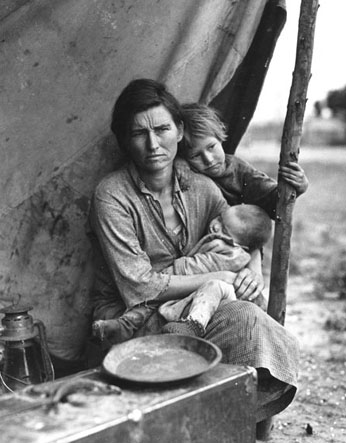
Learn a great deal more about Dorothea Lange
=================================================================
glisten: FAMILY VALUES FIVE: MORE MAMA MUSIC
For more info about the FAMILY VALUES series, go here.
Mama's Family Theme Song
Mom: Oh dear; is it TV time again? This reminds me of a quiz show or of mindless and simple days. Well, at least it's upbeat.
-
Sis: You know what? This one rocks! Shake it, Thelma!
-
Dad: I'm glad that it's short.
Explore this obsessive "Mama's Family" fanpage.
With video clips, including the Mama on Jeopardy episode.
-
Explore TV Tome's Mama's Family episode guide.
-
If you think you can handle the truth, read five complete "Mama's Family" transcripts.
-
Here's a vicious rumour about the never-heard lyrics to this little ditty:
"Joe Hamilto refused to pay Vicki (Lawrence) for the lyrics of the song saying that he could write something better on the back of the toilet in five minutes..."
-
Mama's LEATHER Family
=================================================================
Ruth Brown - "Mama, He Treats Your Daughter Mean (Nashville Version)"
Mom:I like this number; it's Rough-N-Tuff old rock style. It gets an 8 out of 10, but what makes it a "Nashville Version", exactly? This is the song where we find out Mama's not so perfect, is she? Can't even keep after her daughter too well. It sure is sassy and gutsy. I don't believe Ruth takes no shit. While listening to the chorus sing falsetto on "TREAT YO DAUGHTER MEAN", Mom yelps and hoots for awhile.
-
Dad: This late arrangement has a contrived feeling, unlike the 1953 Atlantic original, which is full of the life force of newborn rock and roll. Ruth Brown told Dad Wilson that her father sang with a famous gospel quartet in Tidewater during the 1920's; I believe he may have been James C. Brown, who recorded with the Excelsior Quartet of Norfolk all the way back in 1922.
-
Sis: I saw Ruth Brown in person some years ago and she’s the real deal. I love “Mama”, but I much prefer the original version; it’s tighter, more simple and just has more impact. I could do without the generic guitar solos on this take and the backup singers don’t add much either.
If it ain’t broke, don’t try to fix it.
Buy "Night Train to Nashville: Music City Rhythm & Blues (1945-1970)", the '04 Grammy winning compilation of southern-fried rnb, from Amazon.
"Night Train" is a great listen, with more than a few tracks that I'm likely to sample on here in the future, but those who would like to hear more from Ms. Brown are directed to buy "The Best of Ruth Brown" from Amazon.
-
Explore "Ms. Rhythm's" biography and discography at this extensive fan page.
-
Listen to this intriguing forty-five minute NPR profile/interview of Ruth Brown.
Don't miss her responses to the callers: "They're on the computers. I love that you can find them. I'm not gettin' PAID, but... HA HA HA!"
-
Labels: Family Values, music
Thursday, March 31, 2005

================================================================
glisten: FAMILY VALUES FOUR: MAMA MUSIC
For more info about the FAMILY VALUES series, go here.
Goodie Mob - "Guess Who"
Dad: I find this somewhat more appealing, possibly because the piano adds a little tone color.
However... I'll never be able to get with this kind of music.
-
Mom: This song struck me more as poetry, not music. I'm happy to hear how much these guys appreciate their mommas, but it's pounding. This wasn't ever my planet; these weren't my (our?) issues. I do like the music, even if it is a little on edge, like walking on gilded splinters.
Oh, I do like the chorus where the guy (Cee-Lo) sings at the end. That part is very soothing, very pretty. This is where the blanket comes and wraps the baby up.
-
Sis: I guess I ought to know who these folks are, but again: it's not up my alley.
To comment relevantly on this track, one ought to be more receptive than I find myself. Sorry.
Since the fam didn't put in on this, I feel compelled to say just a BIT more:This is off Goodie Mob's seminal and astonishing first album, Soul Food. This disc had a really big impact on the way I listen to music and (along with Southernplayalisticadillacmuzik) more or less established what "Dirty South" WAS.
The good news for today is that G-Mob is apparently reuniting for a new album. High hopes!
Buy "Soul Food", from Amazon.
-
Read this interview with Khujo Goodie, "the first one-legged MC".
I've yet to hear Livin' Life Like Lumberjacks; can anyone say whether it's worth the purchase?
-
Visit Cee-Lo's official site.
-
Read this brief interview with Big Gipp and watch Gipp's video (with Sleepy Brown!) for his solo single, "Steppin' Out".
=================================================================
Famous Four (A.K.A. The New Orleans Humming Four) - "Mother's Love"
Dad: This song was originally issued on the tiny "Wonder" label in New Orleans in the early 1950's and reissued in the 1980's on the "New Orleans Gospel Quartets 1947-56" compilation that Lynn Abbott programmed and annotated for Bruce Bastin's Gospel Heritage label (HT-306). Lynn also wrote a terrific essay about this group for "Whisky, Women and..." magazine (#11, 1983).
This same quartet recorded R&B for Imperial Records as "The Hawks".
Lynn was kind enough to introduce me to Albert Veal, a member of the Humming Four since they organized in the early '30s. Mr. Veal was a sweet guy and a sure enough lover of four-part vocal harmony.
-
Mom: Well, that drum is odd. For a so-called "love song" this is sad and droning. I just don't get a sense of feeling or family here, except for loss.
-
Sis: This is soothing and certainly musically competent, but I might have chosen something different. What about Booker White’s song about looking for his mother’s grave? Or "Sleep On, Mother"; NJQ did a great version of that one. Or “Motherless Children Have a Mighty Hard Time”; where’s the love for Blind Willie Johnson?
This one is nice, but it doesn’t grab me like the best harmony singing can.
Buy "New Orleans Gospel Quartets: 1947-56" from The Louisiana Music Factory.
This album contains a Humming Four version of the gospel standard "Twelve Gates to the City" that is just STUNNING; it's a much recommended purchase.
-
Read this extensive piece about the RnB exploits of the Famous Four AKA The Hawks.
-
Read a bit about the rich history of New Orleans gospel music.
=================================================================
Labels: Family Values, music
Tuesday, March 29, 2005

Some families can be more difficult than others.
=================================================================
glisten: FAMILY VALUES THREE
For more info about the FAMILY VALUES series, go here.
Washington Phillips - "I Had a Good Father and Mother"
Dad: Phillips recorded this track in Dallas, Texas in 1927. His recordings were pretty much beneath most collector's radar screens until Agram, a Dutch record company, reissued them around 1980 (Agram, 2006). Lynn Abbott found the first photo of Phillips in the black New Orleans newspaper, The Louisiana Weekly.
Scholar James Bryan turned up a photo of a dulceola, presumably the instrument Phillips played, in an advertisement from Jacob's Orchestra Monthly (December, 1911). The text for that ad reads: "Its action, while similar to that of the Piano, is quicker and more simple, and its sweet, soothing tone is much appreciated by invalids who are unable to listen to the louder notes of the Piano. It is portable, being only 24 X 18 inches in size and only 18 pounds in weight, and is easily taken on Yachting and Camping Excursions and Picnic Parties."
I don't think anyone has turned up any solid biographical details about Washington Phillips, but when you piece the bits together, it seems safe to surmise that he MUST have played his dulceola for invalids yachting down the Trinity River.
That's a joke.
There's a guy in Memphis by the name of Andy Cohen who collects and plays dulceolas. They're pretty hard to come by.
-
Mom: What a haunting, bare-boned song! I like this man's voice but the music is so lonely and sad. (My good friend) Diana found this soothing, but I found it a little difficult, very raw. He says a lot in the music without saying much in words; it's minimal. I hear a good message, though: the best things in life can't be bought; "salvation is free for you and me".
-
Sis: This track is just as sweet as honey. Phillips is the undisputed king of the underrated hammered dulcimer sound. He’s so heartfelt and he has a genre-bending quality that really appeals to me; is this gospel? blues? lullaby?
It's just a bit moralizing, but that doesn’t really get under my skin.
Buy "I Was Born to Teach the Gospel", a complete collection of the extant recorded works of Washington Phillips, direct from Yazoo records (you can sample a few tracks in RealAudio at the site).
Phillips' discography includes only sixteen songs and yet is as rich as El Dorado. If you're moved by "Mother and Father," this is a must own disc.
Read loads of arguments and conjectures as to the nature of Phillips' use of the Dulceola.
I'm hardly educated enough to comment on this at all; Hut readers who know better should leave two cents on the windowsill and let a brother know.
-
Read this brief AMG bio of Washington Phillips.
=================================================================
Frank Zappa and the Mothers of Invention - "Mom and Dad"
Dad: Frank Zappa was a smart guy for a rock and roller. The Mothers of Invention's first two albums really shook me up. I meditated (medicated?) on those albums for hours and hours when they first came out.
The Mothers had a regular gig for about two years at the historic NYC Garrick Theater, down on Thompson and Bleeker. I saw them perform lots of times there; they'd put on wild, unpredicatable shows. Back in those days ('66, '67 or so) Zappa would often stand on the street corner to catch some air between shows and if you wanted to talk about his music with him, he was usually up for that. I was young and presumptuous, but I must say, Zappa was never dismissive.
One night he invited me, your mom and a friend of ours to visit his West Village apartment, where he played us We're Only In It For the Money to get our opinion on it. It had yet to be released and would be held up in litigation for many months by Capitol records, who refused to let him get away with the amazing "Sgt. Pepper" spoof cover. It was finally printed up when Zappa and his label agreed to reverse the inner and outer covers on the LP.
-
Mom: Now this I know about. It's vintage Zappa, very typical. That beat is very American Indian, isn't it?
I don't know about that guy; he was always so angry. Whenever he played he had to be shocking and not fit in. He would pick people out of the audience and drag them onto the stage and just abuse them, mock them and belittle them. Every time I went with your father to see him perform, I always thought, "Oh, please don't pick on me!"
He was too much for this world. I appreciate the music he made, but his intensity... woooo! What's his kid's name, Dweezil? He strikes you as a really normal kid, doesn't he? Maybe Zappa made a good home for him.
-
Sis: The Mothers of Invention track really takes me back to my high school days (though they're rapidly shrinking in the rearview mirror), when I was heavy into the "Only In It For the Money" album. This track sure is lyrically powerful, if slightly outdated. Zappa’s cynicism is extremely biting; I wonder if any of the parents of the era really listened to this song and its message? In any case, this is dark and poignant and vaguely operatic; Zappa at his best.
Buy The Mothers' "We're Only In It for the Money", arguably the best album of 1968, from Amazon.
-
Check the personnel and lyrics for every track on the album.
-
Visit Zappa's official page or any number of fan pages.
-
Learn about the plethora of Zappa namesakes in the natural world.
=================================================================
we're having technical difficulties on the client side. be patient with me over the next few...
Labels: Family Values, music
Monday, March 21, 2005

=================================================================
glisten: FAMILY VALUES THREE
For more info about the FAMILY VALUES series, go here.
Manson Family - "Roc-A-Family"
Dad: Huh? "Muthafucka," whaaa? There's nothing here for me at all.
Believe that.
-
Mom: Ugh! I'm having a hard time enduring this torture. This is like somebody chipping at your head. Pass the analgesics. This song(?) is angry and scary and I think I was born in the wrong generation for it.
Boy, did I get in trouble at work when I put this CD on in my office and this came on saying "Fuck you, Fuck him; Fuck EVERYBODY!"
There's no denying the rhythm but it's not spiritually gratifying in any way. It's like the Manson Family is in pain and they're gonna put you in pain out of spite.
It's very street, sounds very street to me. It's hard to interpret and I feel like maybe I should, but... aaaaah, fuck this!
-
Sis: The Manson Family? Is that name some kind of ill-conceived joke?
There is something ugly in the undercurrents of this and although I suppose all of that super-fast vocal action is impressive, it rather sets my nerves on edge.
*************************************
Buy "Heltah Skeltah" from Amazon.
It is, no doubt, an acquired taste.
-
Read this interview with C-Roc, in which he makes his opinions of the Manson Fam pretty gosh-darn clear.
-
Three minutes with Tommy Wright III
-
Explore Memphis Rap, "the premier rap music store and community".
-
Attend the Manson Family Picnic.
I'm strongly recommending you stay away from the potato salad.
=================================================================
The Ramones - "We're a Happy Family"
Dad: I never heard anything I liked by the Ramones. Clearly, I don't get it.
-
Mom: This reminds me of Frank Zappa. It's intense, like somebody chanting, "My troubles never end". Usually "happy" music has a certain tone; in this case, the tune really didn't match the sentiment. I rather doubt this is a happy family, but it doesn't mean they don't love each other.
"Eating refried beans?""Daddy likes men"? I'm having a hard time figuring it out... is this a 'garage band'?
-
Sis: I always feel like I’m supposed to like The Ramones. Maybe it’s living in Memphis; people go for that stuff around here. It's usually not my scene, but I can dig this track. I hear the “rock and roll” musical aspects of it more clearly that is often the case with this kind of garage/punk stuff.
I also like the tongue in cheek nature of the lyrical content. Oh, yes, I’m sure they’re a “happy family”. Nice meltdown toward the end of the track.
*************************************
Buy "Rocket to Russia," the Ramones third try at the big time, from Amazon.
Ramones Mania will also likely do the trick for the non-fanatic.
-
Visit the Ramones official site.
-
Read this interview with Tommy Ramone.
-
RIP Dee Dee, Joey and Johnny.
=================================================================
Labels: Family Values, music
Friday, March 18, 2005

=================================================================
glisten: FAMILY VALUES TWO
For more info about the FAMILY VALUES series, go here.
Family Ties Theme Song
Dad: TV theme songs are to music as billboards are to painting.
-
Sis: TV theme songs are always fun, but I must say that hearing 'Family Ties' brought back plenty of uncomfortable memories of the distinctly bad taste in TV viewing that characterized our many wasted youthful hours.
-
Mom: As sappy as this is, it made me cry. I don't know why; I never watched the show. I like the frisson between their voices; it's gentle and romantic, but the questions they're asking each other make me sad.
Whose voice is the man's? Aaron Neville?
Ouch. No, Mom, not Aaron Neville. This version of "Without Us" is performed by (believe it or not) Johnny Mathis and Deniece Williams.
I was never a fan of this show, but I _DID_ watch it for some reason; I remember my father was always easily worked up by the smarmy uber-republican ethics of Alex. Maybe it was just what he represented.
Visit this Family Ties fanpage for more information than you could possibly need on this 80's sitcom cornerstone, along with numerous soundfiles including the original theme!
-
When did it jump the shark?
-
Sitcoms Online has hundreds of sitcom opening and ending themes.
=================================================================
Sir Lancelot - "Scandal in the Family"
Dad: My friend Ray Funk met and interviewed Sir Lancelot as part of his duties writing the informative liner notes for the 1995 CD reissue of this track (Flyright, CD 942). Ray points out that Lancelot Victor Edward Pinard had extensive training as a singer of classical music; he didn't start singing calypsos until he came to New York in 1940.
-
Mom: What's the scandal and where the hell did you find this song? It's hard to get next to. Is it calypso? It's a funny track because even though it's clearly about a very serious subject, it's such a light and danceable tune. I like the clarinet especially, but let us not forget I used to play the licorice stick myself.
-
Sis: Beautiful, whimsical horn sounds. I often have trouble following Lancelot's narratives. It is, however, clear from this track that something untoward has occurred...
Here's some info on Sir Lancelot from Brad Beshaw's Hollywood DeathWatch Obit:
"Born Lancelot Victor Edward Pinard in Cumuto, Northern Trinidad, the boy who would become the vanguard exponent of Calypso music (years before Harry Belafonte) was already giving classical vocal recitals at age 6... "
The music I'm posting here would have hit the market in the early to mid-40's. Lancelot's honeyed, nasal tenor couldn't be more dated; but his lyrics would fit snugly into any Sean Paul single. Lancelot's singing has a distinct theatrical edge to it, hardly surprising given his extensive film career:
"His first credited role arrived courtesy of RKO producer Val Lewton, for whom Lancelot would make three pictures beginning with 1943's 'I Walked With a Zombie'. In a role more Greek Chorus than character part, Sir Lancelot provides running commentary for cast and audience alike, courtesy of the Calypso number Fort Holland (later covered by folk singer Odetta)...Following his involvement in Lewton's 'Ghost Ship' (1943) and 'Curse of the Cat People' (1944). Lancelot's acting mettle was tested under the direction of Howard Hawks, in Lauren Bacall's auspicious debut (opposite Humphry Bogart), 'To Have and Have Not'. The perfect counterpoint to this sober drama was provided by 'Zombies on Broadway' (1945), an RKO vehicle for its Abbot and Costello knock-offs, 'Carney and Brown' featuring a parody of the Fort Holland song, and a "zombie expert" played by, who else, Bela Lugosi."
Lancelot lived to the ripe old age of 98.
Buy "Trinidad Is Changing", the Lancelot greatest hits album and quite possibly the only album of his work available, from Amazon.
-
Explore this exhaustive Sir Lancelot fansite.
-
Labels: Family Values, music


